📞  — free, 24/7
 — free, 24/7| Package | Price per Dose | Price | |
|---|---|---|---|
| 360 pills | €0.71 | €321.96 €257.57 Free shipping | |
| 270 pills | €0.73 | €245.65 €196.52 Free shipping | |
| 180 pills | €0.76 | €171.21 €136.96 | |
| 120 pills | €0.83 | €124.68 €99.74 | |
| 90 pills | €0.91 | €102.34 €81.88 | |
| 60 pills | €1.01 | €76.29 €61.03 | |
| 30 pills | €1.10 | €40.93 €32.74 | |
| 360 pills | €1.10 | €495.04 €396.03 Free shipping | |
| 270 pills | €1.12 | €377.79 €302.23 Free shipping | |
| 180 pills | €1.15 | €258.68 €206.94 Free shipping | |
| 120 pills | €1.18 | €176.79 €141.43 | |
| 90 pills | €1.22 | €137.71 €110.16 | |
| 60 pills | €1.33 | €98.62 €78.90 | |
| 30 pills | €1.41 | €53.95 €43.16 | |
| 10 pills | €1.58 | €20.45 €16.36 |
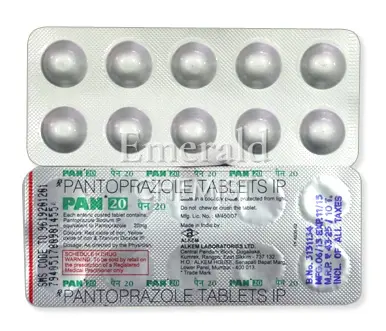
Pantoprazole received FDA approval in 2000 and is now among the most widely prescribed proton pump inhibitors worldwide. As a benzimidazole prodrug, pantoprazole is activated in the acidic milieu of the gastric parietal cell canaliculi to form a sulfenamide that covalently inhibits the H+/K+-ATPase, yielding sustained suppression of gastric acid secretion. Its pharmacologic profile supports use in diverse gastroesophageal conditions and perioperative care requiring acid suppression.
In clinical pharmacology, pantoprazole demonstrates reliable acid suppression with a favorable safety and interaction profile relative to earlier agents in its class. It is available in oral and intravenous formulations, enabling use in both outpatient management and inpatient or perioperative settings. Absorption is partial and enhanced when taken before meals, with a duration of pharmacodynamic effect that outlasts its plasma half-life due to irreversible enzyme inhibition.
Pantoprazole belongs to the class of proton pump inhibitors (PPIs) that target the final common pathway of acid secretion in gastric parietal cells. Structurally, it is a substituted benzimidazole that undergoes activation in acidic environments to yield the active sulfenamide species. The drug's activity is characterized by selective, irreversible blockade of the H+/K+-ATPase, resulting in reduced basal and stimulated acid output for 24 hours or longer with repeated dosing.
Pharmacokinetically, pantoprazole is predominantly metabolized in the liver by cytochrome P450 enzymes, notably CYP2C19 and CYP3A4, with the final disposition via urine and bile. Its pharmacodynamic effect—gastric acid suppression—persists beyond the plasma half-life, reflecting covalent enzyme inhibition. The IV formulation provides rapid onset suitable for acutely ill patients or those unable to take oral therapy.
Clinically, pantoprazole is employed across dyspepsia syndromes, gastroesophageal reflux disease (GERD) with erosive or non-erosive esophagitis, peptic ulcer disease, and hypersecretory states. It is often used in combination regimens for Helicobacter pylori eradication and to prevent NSAID-associated ulcers. In practice, premeal administration optimizes intestinal absorption, and dose adjustments may be guided by hepatic function and clinical response.
When contrasted with other PPIs, pantoprazole tends to exhibit a relatively modest interaction potential with CYP2C19–dependent pathways, yielding a lower likelihood of affecting the activation of certain prodrugs such as clopidogrel. Its metabolism involves both CYP2C19 and CYP3A4, but with a pharmacokinetic profile that shows less pronounced interpatient variability related to CYP2C19 polymorphisms than some earlier agents. Onset of acid suppression is comparable among PPIs, but absorption is optimized by premeal dosing, whereas some agents demonstrate differing food effects.
In terms of clinical applications, pantoprazole and omeprazole/esomeprazole share indications for GERD and erosive esophagitis; however, the choice among them may reflect individual risk of drug interactions, prior tolerance, and physician preference. Pantoprazole’s IV option provides a distinct advantage for perioperative management or hospital settings where oral administration is not feasible. Overall, the class-wide goal remains durable acid control with favorable safety in the majority of patients.
Indicative uses include treatment of GERD with or without erosive esophagitis, relief of heartburn symptoms, and healing of erosive esophagitis. Pantoprazole is also indicated for maintenance therapy to prevent relapse in patients with a history of GERD or erosive disease. In peptic ulcer disease, it promotes mucosal healing and symptom control when combined with appropriate eradication regimens for H. pylori, and it serves as a prophylactic option to prevent NSAID-associated ulcers in at‑risk individuals.
Additional indications encompass hypersecretory conditions such as Zollinger-Ellison syndrome and other causes of excessive gastric acid secretion. In clinical practice, therapy is tailored to symptom control, endoscopic findings, and patient comorbidity. Dosing and duration are guided by clinical response, with careful consideration given to hepatic impairment and potential drug interactions.
Anticipated differences among pantoprazole and closely related PPIs include activation requirements, interaction potential, and certain pharmacokinetic features. The following table provides a concise comparison of 3 representative PPIs to assist clinical decision-making.
| Drug | Activation/Prodrug status | Metabolism and interactions | Typical clinical notes |
|---|---|---|---|
| Pantoprazole | Prodrug activated in acidic canaliculi | Metabolized by CYP2C19 and CYP3A4; relatively lower CYP2C19 inhibition | Lower potential to interfere with clopidogrel activation; useful in patients with variable CYP2C19 status |
| Omeprazole | Prodrug activated in acidic stomach lumen | Strong CYP2C19 inhibition; higher potential for drug interactions | Widely studied with robust data; higher likelihood of interactions with clopidogrel and certain antiretrovirals |
| Esomeprazole | Enantiomer of omeprazole; prodrug | Metabolized by CYP2C19 and 3A4; moderate interaction profile | Similar efficacy to omeprazole with variable interaction risk; often chosen for GERD and erosive esophagitis |
Common adverse events with pantoprazole are generally mild and include headache, diarrhea, nausea, and abdominal pain. Rare but clinically important risks include Clostridioides difficile infection, community-acquired pneumonia, hypomagnesemia with prolonged use, and potential nutrient deficiencies such as vitamin B12 with long-term therapy. As with other PPIs, there is observational evidence linking extended use to fractures in susceptible populations and to rebound acid symptoms upon abrupt discontinuation.
In terms of drug interactions, pantoprazole is less likely than some other PPIs to markedly affect CYP2C19-dependent pathways, which can mitigate interactions with certain antiplatelet agents and other coadministered drugs. Monitoring of magnesium, calcium, and vitamin B12 levels may be prudent with long-term therapy, and dosing should be reassessed in hepatic impairment. Overall, pantoprazole maintains a favorable safety profile for most adults when used as directed and monitored over the intended treatment period.
14–21 days. Free from €179.39 .
5–9 days. €26.91
−10% when paying with cryptocurrency.
−10% on all repeat orders.
All orders are packed in neutral, unbranded boxes with no product name on the outside.