📞  — free, 24/7
— free, 24/7 — free, 24/7| Package | Price per Dose | Price | |
|---|---|---|---|
| 360 pills | €0.64 | €305.36 €229.02 Free shipping | |
| 180 pills | €0.77 | €185.18 €138.89 | |
| 120 pills | €0.81 | €130.01 €97.51 | |
| 90 pills | €0.89 | €106.37 €79.78 | |
| 60 pills | €0.99 | €78.79 €59.09 | |
| 30 pills | €1.92 | €76.82 €57.61 | |
| 360 pills | €0.75 | €362.50 €271.87 Free shipping | |
| 270 pills | €0.83 | €297.48 €223.11 Free shipping | |
| 180 pills | €0.93 | €222.61 €166.96 | |
| 120 pills | €1.02 | €163.51 €122.63 | |
| 90 pills | €1.15 | €137.89 €103.42 | |
| 60 pills | €1.29 | €102.43 €76.82 | |
| 30 pills | €2.07 | €82.73 €62.05 | |
| 360 pills | €1.05 | €504.35 €378.27 Free shipping | |
| 270 pills | €1.17 | €419.63 €314.73 Free shipping | |
| 180 pills | €1.29 | €309.30 €231.98 Free shipping | |
| 120 pills | €1.43 | €228.52 €171.39 | |
| 90 pills | €1.60 | €191.09 €143.32 | |
| 60 pills | €1.77 | €141.84 €106.38 | |
| 30 pills | €2.22 | €88.64 €66.48 |
Amitriptyline was developed in the 1960s and quickly became one of the most widely prescribed antidepressants. As a tricyclic antidepressant, it increases mood-related brain chemicals and modulates signals tied to sleep and pain. Today it remains a common option for mood support, chronic pain, and sleep issues when symptoms overlap.
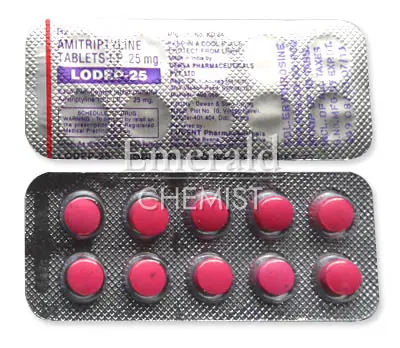
Amitriptyline is a tricyclic antidepressant (TCA) used to treat major depressive disorder and related mood conditions. It is taken by mouth as a tablet or sometimes as a compounded form, with dosing guided by a clinician. The medicine acts on several brain pathways and can affect pain and sleep in addition to mood.
Primary indications: The main use is major depressive disorder, where amitriptyline can ease persistent low mood, sleep disturbance, and appetite changes. It is also used for certain anxiety symptoms when depressive features are present, and for sleep disruption linked to mood disorders. In some patients, it supports longer-term mood stabilization during therapy.
Secondary indications: It is prescribed for various chronic pain conditions, including neuropathic pain and fibromyalgia, where mood effects and pain modulation can help. It is sometimes used for migraine prevention and other functional pain syndromes. Some patients take it to aid sleep when insomnia accompanies pain or anxiety. The exact choice depends on symptoms, medical history, and tolerability.
Amitriptyline primarily blocks the reuptake of serotonin and norepinephrine, increasing these mood-related chemicals in brain circuits. This helps improve mood, energy, and motivation for many people.
The drug also blocks other receptors, including histamine and acetylcholine receptors. These actions contribute to sedation and certain side effects, and they help dampen pain signals by modulating pain pathways. The combination of mood, sleep, and pain effects can be beneficial when symptoms overlap.
Common side effects include drowsiness, dry mouth, constipation, blurred vision, and weight gain. Dizziness on standing and slowed thinking can occur, especially at treatment start or with dose changes.
Safety notes: avoid combining amitriptyline with monoamine oxidase inhibitors and certain other medicines. Do not drink alcohol, and inform your clinician about other prescriptions, supplements, or medical conditions. Older adults may be more sensitive to side effects and to urinary retention or falls. Seek medical advice for signs of serious reactions or mood changes, including thoughts of self-harm, particularly in younger people.
14–21 days. Free from €178.03 .
5–9 days. €26.70
−10% when paying with cryptocurrency.
−10% on all repeat orders.
All orders are packed in neutral, unbranded boxes with no product name on the outside.