📞  — free, 24/7
— free, 24/7 — free, 24/7| Package | Price per Dose | Price | |
|---|---|---|---|
| 360 pills | €0.58 | €245.64 €208.79 Free shipping | |
| 270 pills | €0.65 | €208.11 €176.89 Free shipping | |
| 180 pills | €0.73 | €153.52 €130.49 | |
| 120 pills | €0.91 | €129.63 €110.19 | |
| 90 pills | €1.02 | €107.46 €91.34 | |
| 60 pills | €1.16 | €81.87 €69.59 | |
| 30 pills | €1.74 | €61.40 €52.19 | |
| 360 pills | €0.70 | €295.11 €250.84 Free shipping | |
| 270 pills | €0.73 | €230.29 €195.74 Free shipping | |
| 180 pills | €0.81 | €172.28 €146.44 | |
| 120 pills | €0.86 | €121.11 €102.94 | |
| 90 pills | €0.97 | €102.34 €86.99 | |
| 60 pills | €1.04 | €73.34 €62.34 | |
| 30 pills | €1.12 | €39.22 €33.34 | |
| 360 pills | €0.71 | €300.23 €255.19 Free shipping | |
| 270 pills | €0.80 | €254.17 €216.04 Free shipping | |
| 180 pills | €0.87 | €184.22 €156.59 | |
| 120 pills | €0.96 | €134.75 €114.54 | |
| 90 pills | €0.99 | €104.05 €88.44 | |
| 60 pills | €1.16 | €81.87 €69.59 | |
| 30 pills | €1.74 | €61.40 €52.19 | |
| 360 pills | €0.88 | €375.29 €319.00 Free shipping | |
| 270 pills | €0.90 | €284.88 €242.14 Free shipping | |
| 180 pills | €0.91 | €192.75 €163.84 | |
| 90 pills | €0.99 | €104.05 €88.44 | |
| 60 pills | €1.09 | €76.75 €65.24 |
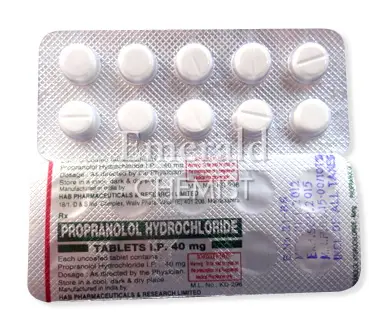
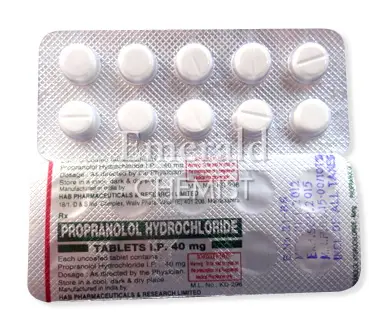
Hypertension, ischemic heart disease with angina, and certain tachyarrhythmias are among the clinical scenarios in which beta-adrenergic blockade improves hemodynamics and reduces myocardial work. Propranolol is a nonselective beta-adrenergic receptor antagonist that blocks both beta-1 and beta-2 receptors, thereby decreasing heart rate, myocardial contractility, AV conduction, and renin release. In addition, its high lipophilicity permits central nervous system penetration, which underpins some of its noncardiac effects, including migraine prophylaxis and performance-related anxiety. The agent is formulated for oral administration in immediate-release and sustained-release forms and is extensively metabolized in the liver, producing active metabolites that contribute to duration of action.
Pharmacodynamically, propranolol reduces sympathetic tone and alters the balance between myocardial oxygen supply and demand. Clinically it is categorized as a nonselective beta-blocker with membrane-stabilizing activity at high concentrations. The pharmacokinetic profile features substantial first-pass hepatic metabolism, variable bioavailability among individuals, and a terminal half-life that supports multiple daily dosing for certain regimens. Caution is advised in patients with obstructive airway disease or diabetes due to beta-2–mediated bronchial and metabolic effects.
Within the beta-blocker class, propranolol is distinguished by nonselectivity and relatively high lipophilicity, properties that confer CNS penetration and a broader pharmacologic footprint compared with beta-1–selective agents. By contrast, metoprolol is predominantly beta-1 selective and generally exhibits fewer central nervous system effects, a consideration when treating patients with asthma or sleep disturbance. Nadolol is also nonselective but tends to have a longer duration of action and lower CNS penetration, limiting some central adverse effects.
Other nonselective agents (e.g., carvedilol) add vasodilatory or additional receptor-blocking properties (alpha-1 blockade with carvedilol), which influences blood pressure effects and tolerability. Sotalol combines beta-adrenergic blockade with class III antiarrhythmic activity, altering rhythm management but with a distinct arrhythmic risk profile. These pharmacodynamic differences help guide drug selection in hypertension, ischemic heart disease, tachyarrhythmias, and preventive strategies for migraine or tremor.
Propranolol is indicated for essential hypertension as part of a comprehensive cardiovascular regimen where beta-blockade is appropriate, and for relief of angina pectoris by lowering heart rate and contractility. It is also employed to control rate in supraventricular tachyarrhythmias and to suppress ventricular rate during atrial fibrillation or flutter after conversion therapy. In preventive neurology, propranolol is used to reduce the frequency and severity of migraine attacks in adults, and it has a well-established role in the prophylaxis of essential tremor and certain performance-anxiety states. Off-label usage for thyrotoxic symptoms—such as tachycardia and tremor—can occur to bridge symptomatic control until definitive therapy is established.
Therapeutic regimens are individualized and consider comorbid conditions, particularly pulmonary disease, diabetes, and conduction abnormalities. In some patients, propranolol may be combined with other antihypertensives or antianginal agents to achieve target blood pressure or symptomatic relief, while monitoring for additive bradycardic or hypotensive effects. Renin-angiotensin-aldosterone system inhibitors, diuretics, and calcium channel blockers may be coadministered, with attention to pharmacodynamic interactions and the risk of excessive bradycardia or heart block.
Specific pharmacologic contrasts with two commonly used beta-blockers are summarized in the table that follows. The table highlights receptor selectivity, central nervous system effects, and typical clinical implications to aid substitution decisions in a pharmacy setting.
| Drug | Beta receptor selectivity | CNS penetration | Typical indications |
|---|---|---|---|
| Propranolol | Nonselective (β1 and β2) | High | Hypertension, angina, arrhythmias, migraine prophylaxis, tremor |
| Metoprolol | β1-selective | Moderate | Hypertension, ischemic heart disease, heart failure (selective use) |
| Nadolol | Nonselective | Low CNS penetration | Hypertension, angina |
Adverse effects commonly associated with propranolol include bradycardia, hypotension, fatigue, dizziness, and cold extremities due to reduced cardiac output and peripheral vasoconstriction. Bronchospasm or wheeze may occur in susceptible individuals with asthma or COPD because of nonselective beta-blockade. Glycemic responses may be blunted, and hypoglycemia awareness can be impaired in patients receiving concomitant insulin or sulfonylureas. Caution is required in patients with conduction abnormalities, heart block, uncompensated heart failure, or severe bradycardia; abrupt withdrawal after chronic use may precipitate tachyarrhythmias or rebounded hypertension.
Drug interactions of clinical relevance include concomitant calcium channel blockers with negative inotropic or chronotropic effects, partial hepatic impairment affecting metabolism, and certain antiarrhythmics. Propranolol crosses the blood-brain barrier, contributing to central effects such as fatigue or sleep disturbance, which may influence patient adherence. In pregnancy, propranolol is categorized for use only when clearly needed, with monitoring for fetal growth and neonatal outcomes, as with other beta-blockers. Overall, safety is enhanced by careful patient selection, dose titration, and regular monitoring of heart rate, blood pressure, and respiratory status.
14–21 days. Free from €174.71 .
5–9 days. €26.21
−10% when paying with cryptocurrency.
−10% on all repeat orders.
All orders are packed in neutral, unbranded boxes with no product name on the outside.